


Chantel Lynn Barber, Some Things Don’t Change, acrylic. All images courtesy of the artist, shared with permission.
Chantel Lynn Barber is a contemporary portrait artist specializing in expressive acrylic paintings that prioritize emotional depth over rigid realism. By utilizing a "loose impressionistic" style and strategic use of acrylic inks and lost-and-found edges, Barber captures the "spirit beneath the surface" of her subjects. This feature explores her transition from oil to acrylics and her pursuit of spontaneity and "bravado" in modern portraiture.
Chantel Lynn Barber: Expressive Contemporary Portraits in Acrylic
Chantel Lynn Barber paints with an eye tuned to what lies beneath the surface. Her portraits capture not just a likeness but the beauty of the human spirit.
Chantel Lynn Barber is a contemporary portrait artist whose work reveals a deep reverence for the splendor and complexity of the human spirit.
Working primarily in acrylic, she crafts paintings that feel both intimate and atmospheric, weaving together hints of memory, literature, and storytelling. Her command of light and shadow, paired with textured surfaces, bold color, and confident brushwork, gives each piece a sense of immediacy and emotional depth.
Barber’s portraits invite viewers to experience quiet moments of reflection and connection, encouraging them to linger, look closer, and consider the layered essence of a life captured on canvas.
Recently, we spoke to Barber about her work.

Chantel Lynn Barber, Miracles, acrylic.
Can you tell us about your artistic journey?
At 12 years old, I opened a copy of American Artist Magazine and was mesmerized by two artists in the issue – a detailed photo-realist painter and another with a more painterly style. Although both artists were incredible, I found myself pulling the magazine out repeatedly to study the work of the second artist. I loved the painterly details and the passages that were not completely rendered — they were unfinished yet fully complete. This was a style that made my heart sing.
However, I grew up in a rigid and controlled environment that made it challenging to paint with spontaneity. It wasn’t until 2002, when a portrait magazine caught my eye, that I saw the same artist featured again. Memories came back, and this time I knew I needed to paint in the looser impressionistic style I always dreamed of working in.

Chantel Lynn Barber, Warm Heart, acrylic.
Why have you chosen acrylics as your primary medium?
I love the quick dry time of acrylic. It forces me to overcome fussiness and focus on laying brushstrokes down intentionally and effectively. When I worked in oil, I could regress to being a timid painter. But when I work in acrylic, I have to be decisive, which makes me create with ambition, assurance, and bravado. I would rather have an audacious failure in a painting than a timid half-success.
How do you incorporate acrylic inks?
Acrylic inks are fluid with lovely color saturation that can achieve both opaque and transparent paint passages. Their versatility lets me achieve effects such as drips, delicate splattering, color washes, and beautiful, flowing lines. They create rich darks, and I love using them to add transparent washes of lights and darks, which let me describe things visually in subtle ways that paint alone often cannot do.

Chantel Lynn Barber, Choose Me, acrylic.
Can you walk us through how you strategically use lost and found edges?
Artist John Howard Sanden said of his mentor Samuel Oppenheim that “the colors and tones (in his painting) seemed to float and shift with a palpable aliveness. The edges of the forms shimmered and melted one into another, creating sheer loveliness.” I read those words long ago, and that’s how I’ve thought of lost and found edges ever since.
I begin a painting using middle values, working into the lights and darks, saving the lightest lights and darkest darks for finishing touches. I’m working the entire painting everywhere at once, so as the face or figure emerges, I instinctively begin to know where I want the lost, found, and blurred edges to be. The edges are vital to conveying emotion and a sense of atmosphere in my work.
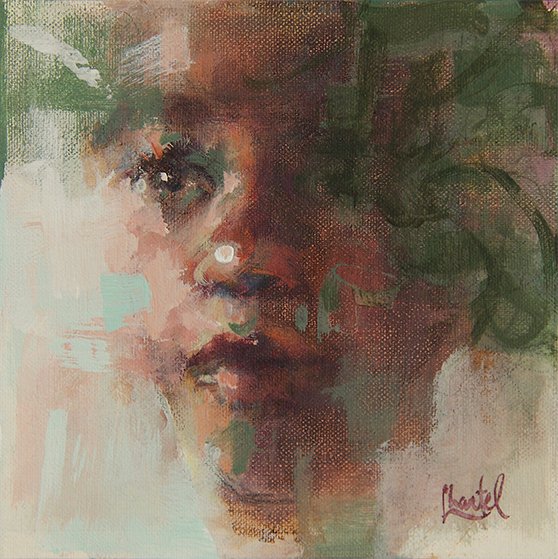
Chantel Lynn Barber, Dryad, acrylic.
You’ve said that your loose, impressionistic style allows you to capture your artistic vision of the splendor found in the human spirit. How do you paint that quality?
Subtlety, subtlety, and more subtlety. The human spirit is always shifting between emotions and ideas. It is fluid and not easily captured, so I use subtlety as I work. I do this by using layers of paint. Sometimes a layer may have just a bit peeking through but never underestimate how important this is to create subtlety in a painting. Just a hint of a color or a brushstroke can change everything, especially when creating portraits and figure work. Whispers of paint passages can be just as effective as the bold brushwork that is so vital in my work.

You often work from reference photos you take yourself. How do you render volume and space when working with photos?
Because I know a photograph flattens the image, I study my subject throughout the picture-taking process, making mental notes.
When it comes time to paint, the photos become visual reminders of the mental notes made. I am always aware of the rhythm of a face or figure. This rhythm is one of the most important ways to render space in a painting and is made up of angles and directional lines that create the final shapes I see. Laying down brushstrokes in such a way that they follow the form is how I create volume in a painting.
Instead of painting in a detailed, realistic style, you suggest a form or a face through impressionistic layers of paint and gestural marks. What does this approach add to the finished work that realism might not?
It allows the paint more space to speak in a way that realism might not. I believe we each have a spirit. So I am not just trying to convey the shell of the body with paint, but the spirit within. To me, painting tight seems unyielding, while the suggestive approach adds weight to a piece, creating a lovely sense of mystery and depth. I watch the painting emerging and respond to what is happening in front of me. The thing that makes an artist unique is how they interpret realism.
Chantel Lynn Barber, Thinking Good Things, acrylic.

Chantel Lynn Barber, And the Wind Lifted Her, acrylic.
How do you define a successful painting?
An unsuccessful painting is one that each time I walk by it, I feel disappointment. A successful painting is one that when I walk by it, it stops me no matter how many times I’ve already seen it, and I ask myself: how did I get these effects, and I must do it again!
What do you hope a viewer experiences when they see your work?
The power of the suggestive; the longing to take a closer look; the feeling of mystery. Hoping each time you look at the painting you will see something different and it will tell a story that resonates.
Barber’s award-winning work has been featured in numerous shows and exhibitions and can be found in private and public collections worldwide. She is represented by dk Gallery in Marietta, GA.