

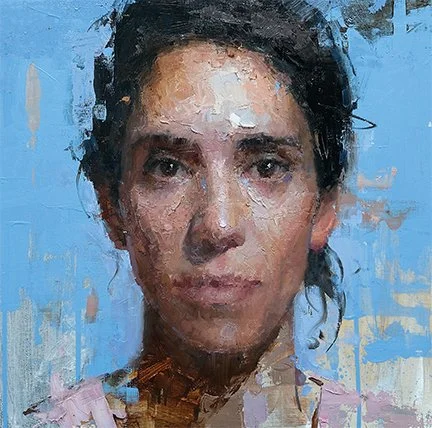
Jacob Dhein, Olga, oil. All images courtesy of the artist, shared with permission.
Jacob Dhein
Jacob Dhein’s paintings, while grounded in tradition, are unmistakably contemporary. His deft altering of realism through abstraction, distortion, and fractured forms results in bold images both recognizable and otherworldly.
He was always interested in drawing, but Jacob Dhein’s serious engagement with art began in college when, on a whim, he enrolled in a figure drawing class. He then took a course in sculpture, which solidified his newfound passion.
After graduating, Dhein worked on commissions, taught art, and bartended to support his practice, eventually earning his MFA from Academy of Art University in San Francisco. It was there that he discovered that having a strong background in traditional art lets an artist paint successfully in any style.
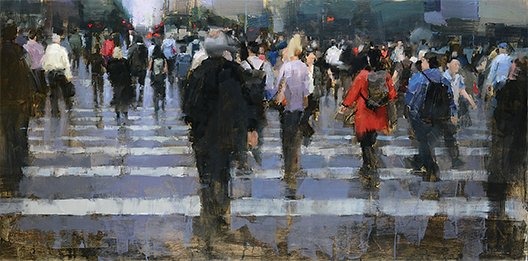
Jacob Dhein, San Francisco Embarcadero, oil. All images courtesy of the artist, shared with permission.
Dhein’s academic foundation, paired with years of artistic exploration, has resulted in a style of Disrupted Realism, grounded in classical training yet unmistakably contemporary. By deliberately altering a traditional realism approach using abstraction, distortion, or fractured forms, his images feel both familiar and slightly otherworldly.
Dhein’s current work is defined by an interplay between immediacy and refinement, using energetic, bold marks so when viewers initially see a painting, they have visceral “first impact” experience before the image resolves into expressive figures, portraits, or atmospheric cityscapes. This gives his paintings a dynamic presence and invites the audience to experience his work both up close and at a distance.
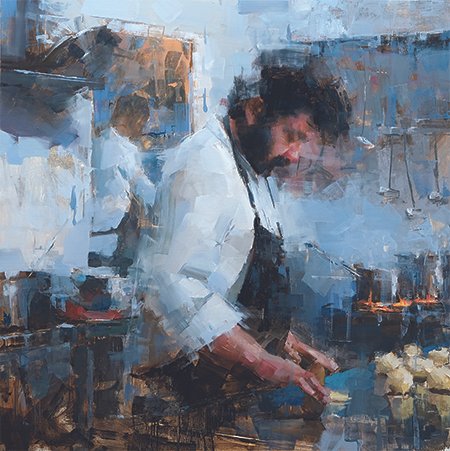
Jacob Dhein, Kitchen 1, oil. All images courtesy of the artist, shared with permission.
In his figurative pieces, he often strips away the environment of a scene to push the boundaries of representation against abstract backgrounds. Conversely, his cityscapes embrace urban complexity, using fragmented areas to mimic the rhythmic pulse of a busy street.
Today, Dhein remains committed to painting from life, a practice he values for its spontaneity and the disciplined focus required to keep his work feeling alive and contemporary.
We spoke with Dhein about his distinctive artistic sensibility.
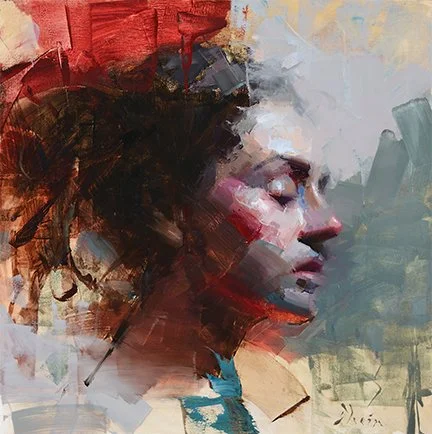
Jacob Dhein, Portrait with Red and Green, oil. All images courtesy of the artist, shared with permission.
In his figurative pieces, he often strips away the environment of a scene to push the boundaries of representation against abstract backgrounds. Conversely, his cityscapes embrace urban complexity, using fragmented areas to mimic the rhythmic pulse of a busy street.
Today, Dhein remains committed to painting from life, a practice he values for its spontaneity and the disciplined focus required to keep his work feeling alive and contemporary.
We spoke with Dhein about his distinctive artistic sensibility.
You seem to move freely between busy cityscapes and figurative/portrait work. Do they require a different “energy” from you, or are you looking for the same building blocks in both?
With figures and portraits, I focus on the human form, so I keep the surroundings simple. That allows me to treat the background as an abstract space in which the subject can be deconstructed and move away from strict realism. In my cityscapes, the background is complex. In both cases, I fragment certain areas to create a sense of movement. Creating deconstructed areas in contrast to smoother areas builds a sense of rhythm and harmony across the painting that keeps the viewers engaged as their eye moves through the composition.
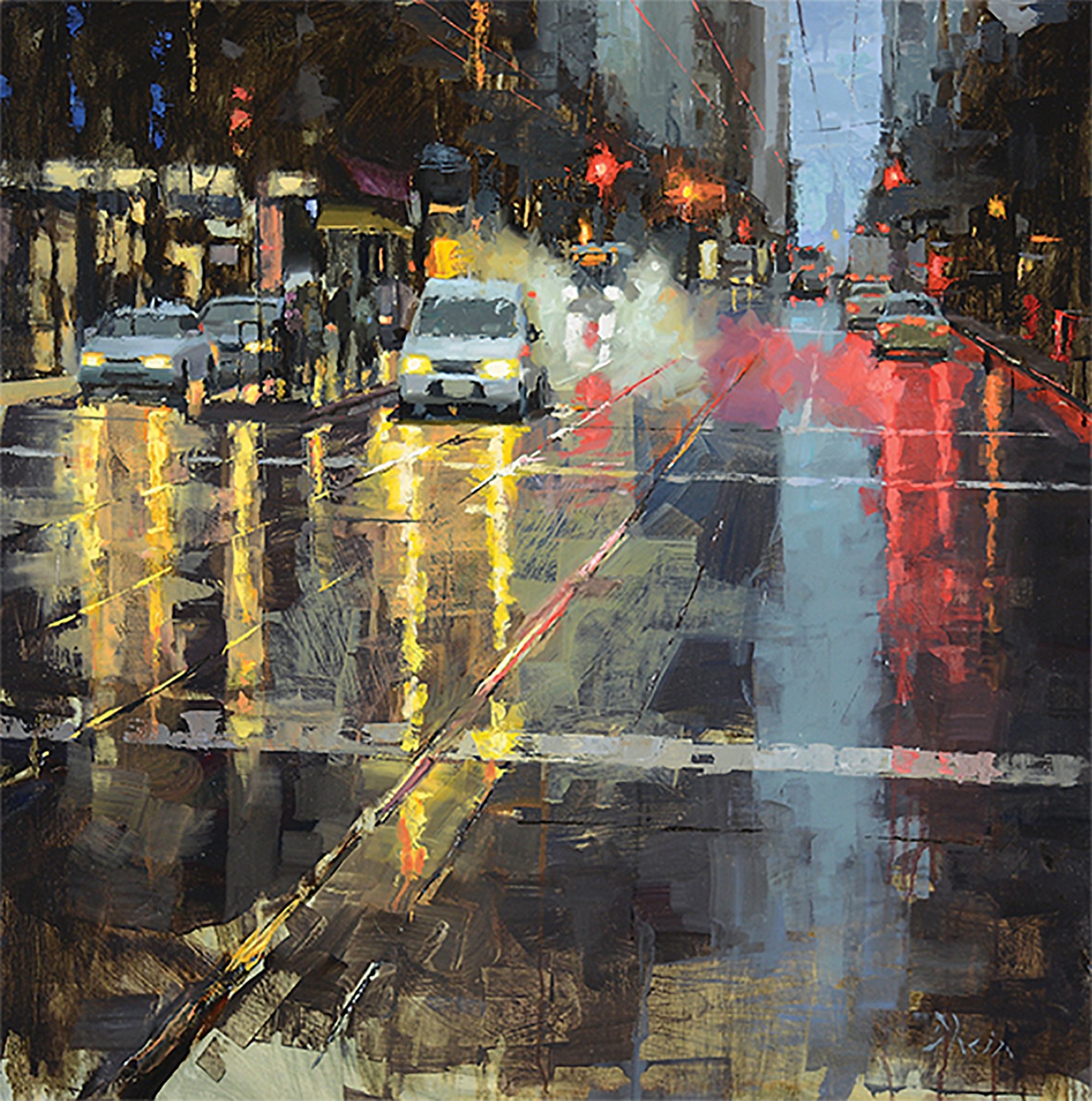
Jacob Dhein, Early Morning on Market Street, oil. All images courtesy of the artist, shared with permission.
Do you work from your own photographs, and do these contribute to determining a painting’s palette and composition?
Yes, I do take my own photos. Other than commission paintings, there have been only four exceptions in the last 20 years where I used other people’s photos. The photo reference itself usually doesn’t inspire me to paint with a certain palette and style. It has a lot more to do with the feeling I had during the photo shoot or the day that I took the pictures.
For example, if I take photos of a musician or dancer, the first painting of them is based on an intuitive feeling I had while I was taking the photos. The same goes for when I take photos for a cityscape painting.
How did you develop your painting style using a variety of tools — brushes, palette knives, squeegees, brayers — to convey movement, visual energy, and emotion?
I think the more I paint, the more my painting style evolves. I would say my starting point was traditional realism that has developed into an impressionistic feel. I learned about the tools I use in a cityscape class I took when I was getting my MFA. The brayer and squeegee felt awkward at first, but after experimenting with them I began to integrate them into my studio work.
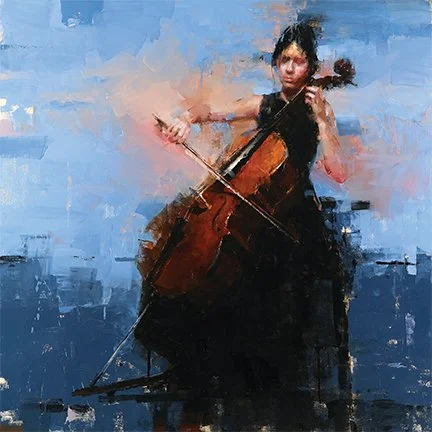
Jacob Dhein, Classical Musician #3, oil. All images courtesy of the artist, shared with permission.
How do you decide which details to include to anchor a painting in realism and which ones to let “dissolve” to better capture the energy and rhythm of your subject?
There’s a lot of trial and error until I find a balance that feels comfortable for me when I look at the painting. A lot of the dissolving of areas is done through intuition at first. Then, as the painting progresses I will sometimes repaint them back into realism. But at the end, I might dissolve it partially or fully again.
You leave much of the visual map of your paintings exposed. Do you do this to show viewers how to look at a piece?
Yes, in a sense. I like to think of artists as composers. We direct the viewer where to go in the composition by using color, edges, contrast, value, and different degrees of realism/abstraction.
What do you want the viewer to feel when they see your work?
My intent is to create something beautiful for a viewer, and in their own way to find that beauty themselves. They might see or feel something different than I do, but if they find a connection to a painting, then I believe it’s a success.
Dhein is represented by Anne Neilson Fine Art in Charlotte, North Carolina; LePrince Gallery in Charleston, South Carolina; Galerie L’Oeil du Prince in Biarritz, France; Abend Gallery in Denver, Colorado; and Wish Gallery at Jessup Cellars in Yountville, California
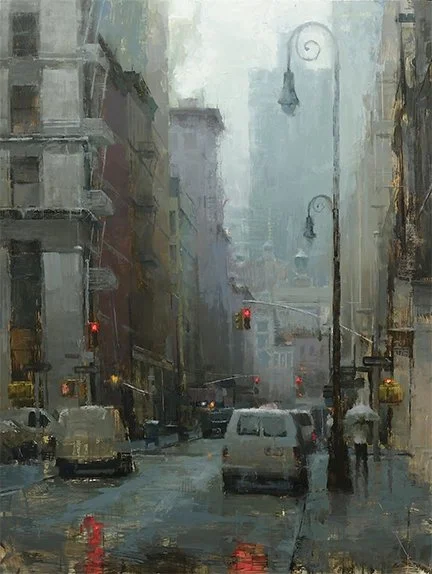
Jacob Dhein, December Morning in New York, oil. All images courtesy of the artist, shared with permission.