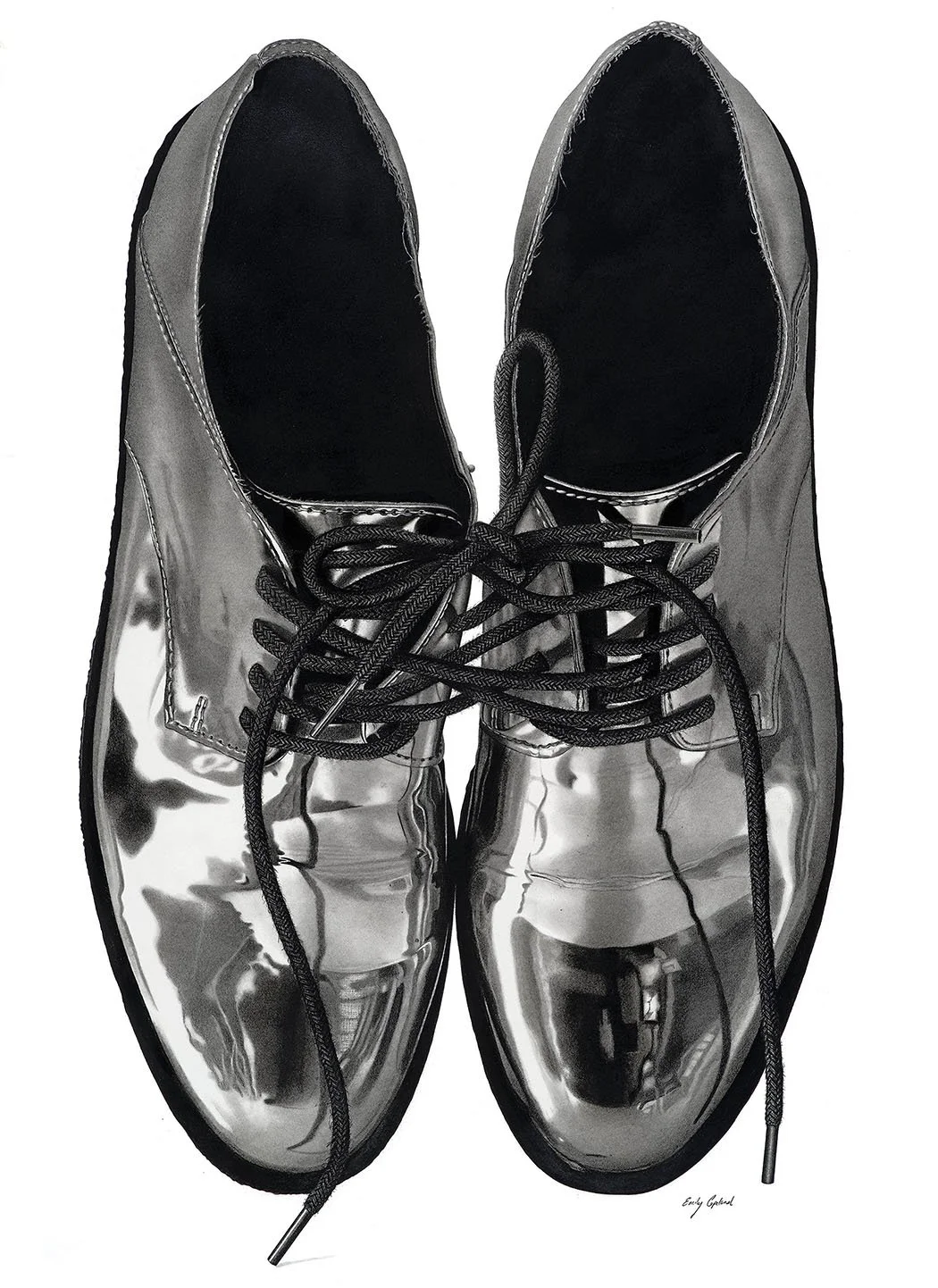
3rd Place Winning Entry | 2025 Still Life/Florals
Emily Copeland, “Shoes,” charcoal, 36.5 × 54.5 inches.
All images © Emily Copeland, shared with permission.
EMILY COPELAND | 3RD PLACE
2025 STILL LIFE/FLORALS COMPETITION
Canadian artist Emily Copeland approaches realism with a precision that borders on reverence. Using charcoal, she scales ordinary vintage objects to dramatic proportions, transforming them into powerful visual statements while stirring memory and human experience.
Enlargement is central to her artistic voice. By rendering vintage objects at a scale that dwarfs their real-world presence, Copeland invites viewers to encounter them anew. Minute textures, subtle wear, and the history embedded in each surface become impossible to ignore. Objects set against crisp, uncluttered backgrounds feel suspended between eras. They are rooted in the past, yet presented with contemporary clarity.
Copeland shared her artistic journey and why she creates monumental works.
Can you tell us about the journey that led you to realism?
Realism has always been my visual language. From a young age, I was instinctively drawn to drawing what I could see — objects, light, texture — and understanding how things were constructed visually. For me, realism wasn’t a limitation; it was a foundation.
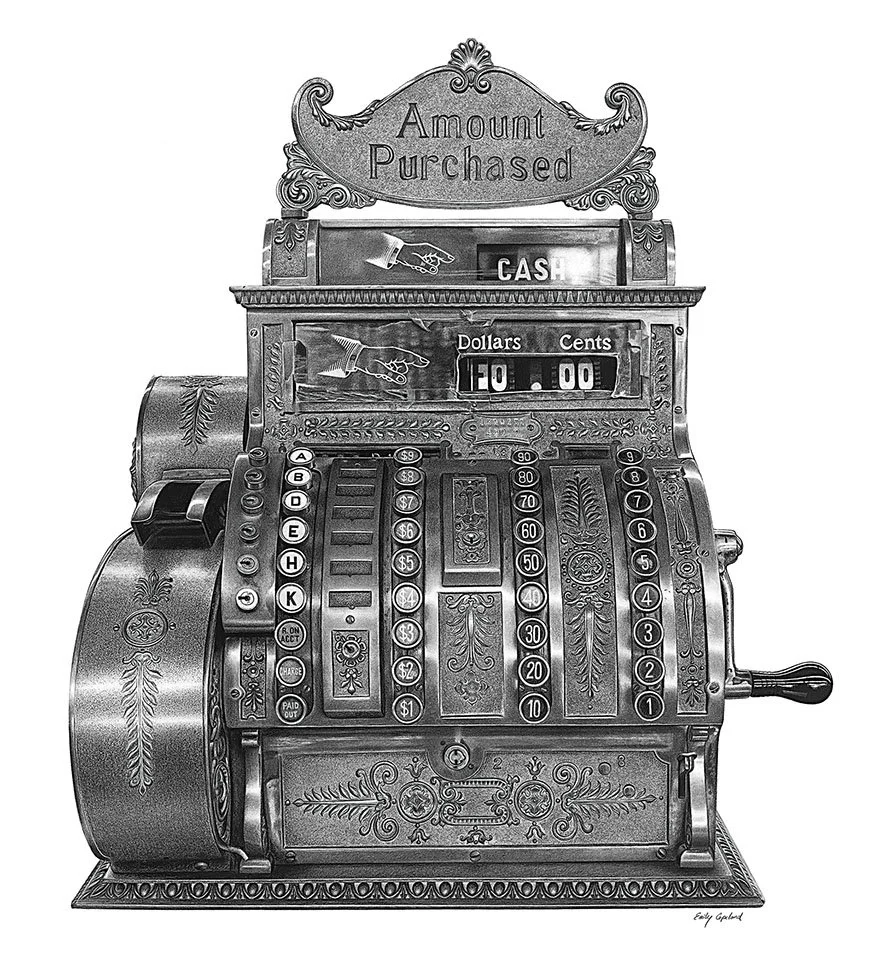
“Cash Register,” oil
My relationship with realism deepened when I began working with charcoal and focusing on objects rather than figures. I started drawing ordinary household items — books, clothing, teacups — objects that exist quietly in our daily lives. At the time, most charcoal artists I encountered were committed almost exclusively to portraiture, while still-life realism was often reserved for painting or color-based media. That gap intrigued me.
As my work evolved, I gravitated toward vintage and antique objects. I’ve always been fascinated by craftsmanship — by things that were once made slowly, intentionally, and beautifully. These objects carry both intrinsic value and emotional weight. When I began rendering them in charcoal, people started responding with their own memories: “My parents had this,” or “I remember this from my childhood.” That was the moment I realized my work wasn’t just about realism, it was about memory, nostalgia, and connection.
Why do you use charcoal as your primary medium?
Charcoal feels inevitable to me now, but it took time to get there. Early on, I primarily worked with graphite, but I consistently felt limited by its tonal range. I was searching for depth — for truly rich blacks and dramatic contrast inspired by the chiaroscuro of Baroque painters like Caravaggio and La Tour. Graphite simply couldn’t take me where I wanted to go.
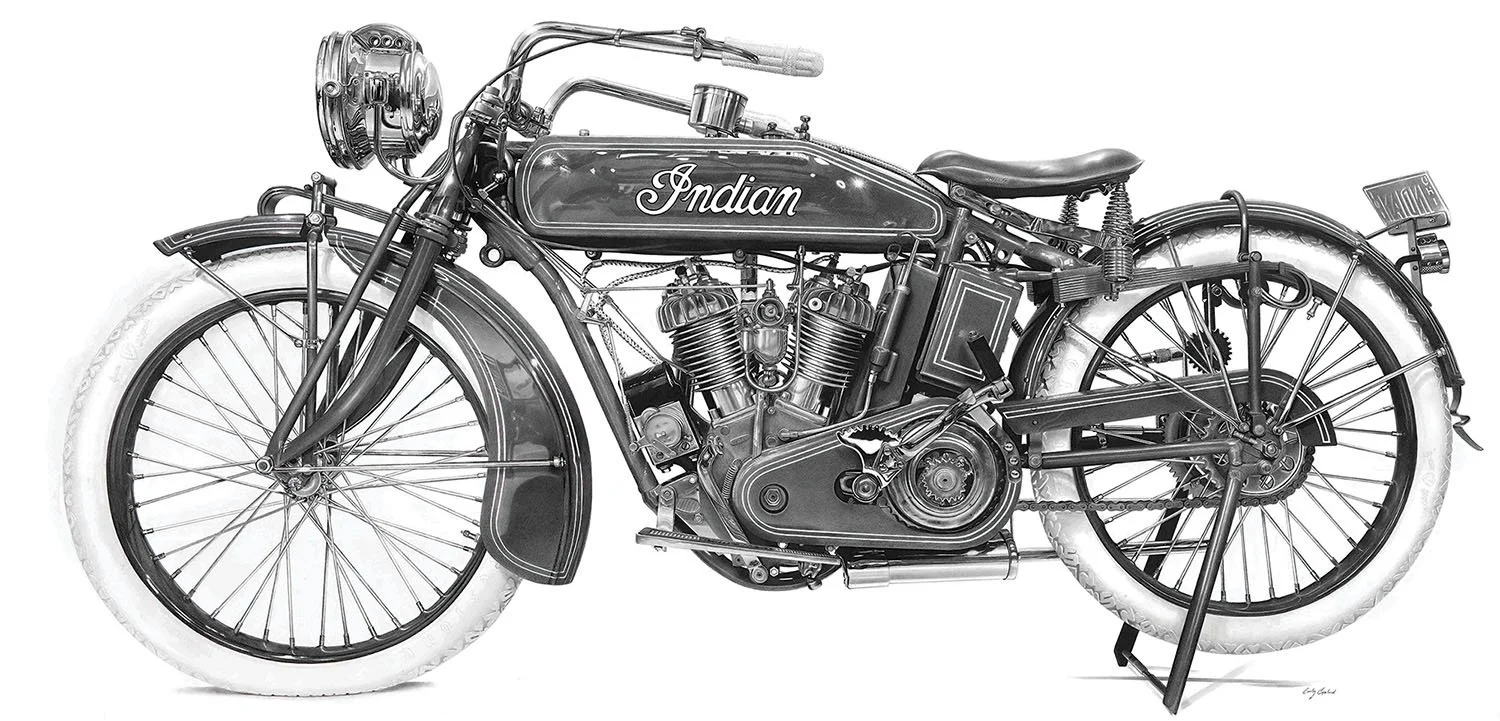
“Motorcycle,” oil
For a long time, I turned to painting to achieve that intensity of light and shadow. Then, during university, I discovered charcoal, and it immediately felt like the missing piece. Charcoal allowed me to reach the full spectrum of value I had been chasing for years — from velvety blacks to delicate highlights — while maintaining the precision and control I love about drawing.
Charcoal is direct, physical, and honest. It records every decision, every touch. It suits my desire for meticulous realism while still allowing for expressive depth. At this point, it doesn’t feel like a choice; it feels like a partnership.
What inspired you to create such large-scale pieces?
Scale is essential to how my work functions. By enlarging objects far beyond their original size, I invite viewers to slow down and truly look. Details that would normally be overlooked — a scratch, a seam, a reflection — become dominant visual elements.
Working on a large scale allows me to create a subtle sense of surrealism while remaining firmly rooted in realism. The object is familiar, yet the experience of seeing it is entirely new.
I’m interested in shifting perspective, encouraging viewers to notice the quiet complexity of things they might otherwise dismiss as ordinary.
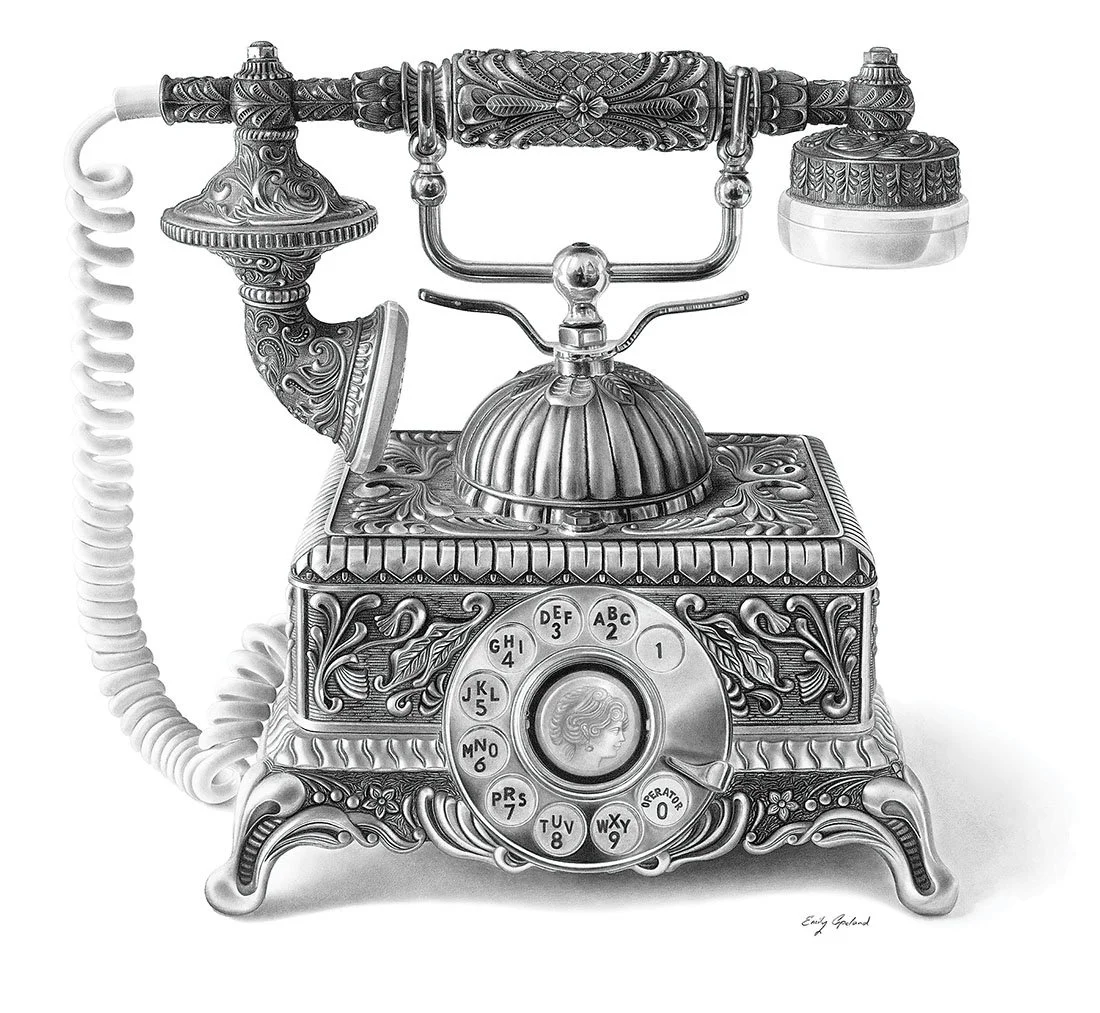
“Vintage Telephone,” charcoal
In your charcoal drawing “Shoes,” the size of the piece is impressive (36.5 × 54.5 inches) and the negative space surrounding the subject creates its own separate rhythm. How do you determine how to present negative space in your work?
Negative space is just as intentional as the object itself. I use white space to allow the subject to breathe, to feel as though it’s suspended, almost floating.
The amount of negative space varies depending on the subject and composition, but balance is always my guiding principle. Too much white can overpower the drawing, while too little can make the object feel confined. I think of negative space as a quiet counterpoint — it creates rhythm, stillness, and focus without competing for attention.
What do you hope people see and feel when viewing your work?
I hope viewers feel a sense of recognition — not just visually, but emotionally. I also work with a wide range of subjects so that the work can resonate with different people in different ways. If someone walks away more attentive to the world around them, carrying a renewed awareness of history and a deeper connection to personal memory, then the work has done its job.
Copeland is represented by RJD Gallery in Romeo, Michigan.