1st Place Winning Entry | 2025 Wildlife/Animals
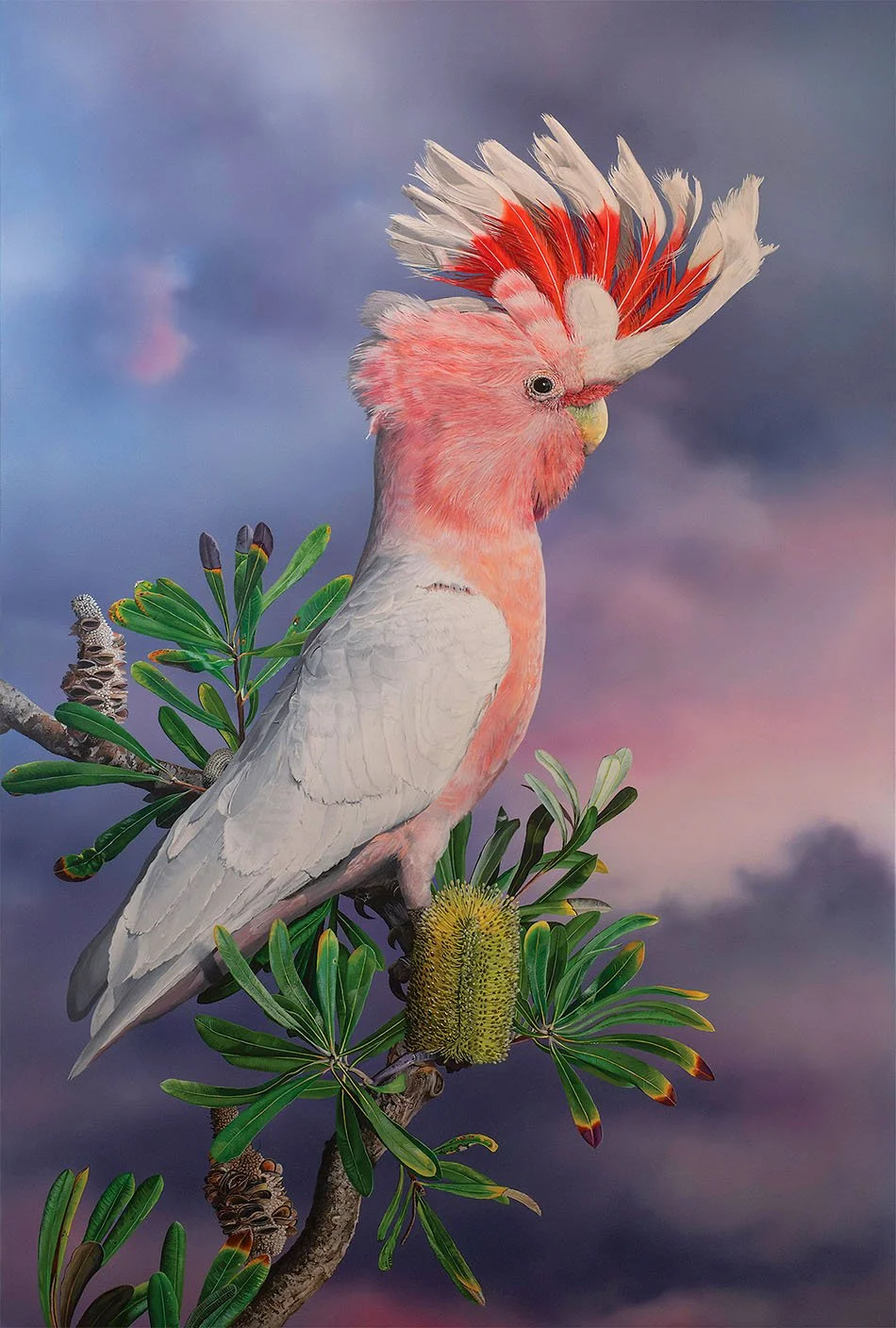
Greg Oakley, “Pink Cockatoo,” acrylic, 34 × 42 cm. All images © Greg Oakley, shared with permission.
GREG OAKLEY | 1ST PLACE
2025 WILDLIFE/ANIMALS COMPETITION
Australian wildlife artist Greg Oakley meticulously creates extraordinary hyperrealist bird paintings. He describes his practice simply and precisely: “I build images feather by feather, hair by hair, mapping light, form, and anatomy so the animal feels truly present.”
Working primarily in acrylic, Oakley aligns himself with the great wildlife artists of earlier centuries, citing the ambition of James Audubon and John Gould and the romanticism of the Dutch Masters. In this artistic lineage, art and natural science meet on the canvas.
“Each painting is a small act of respect for the subject, and for the places it depends on,” he says. That ethos guides the stillness and clarity in his work: images that invite viewers to slow down, look closely, and consider what might be lost if these creatures disappear. If his paintings hold your attention long enough to truly see the animal, Oakley believes, then the work has done its job.
We asked Oakley about the methods and decisions that shape his work.
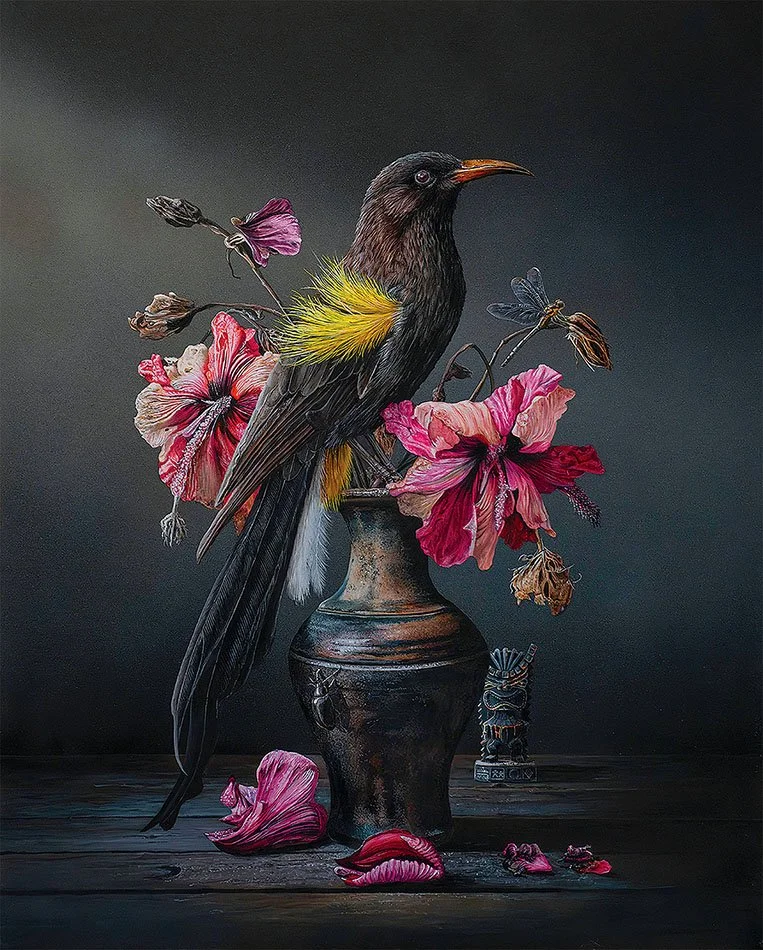
“Hawaii O'O,” acrylic, 62 x 51.5 cm
Tell us about your artistic journey.
My fascination with natural history began in childhood, growing up in suburban southeastern Australia. I was forever turning over stones to find ants, watching birds in the backyard, poking around rockpools at the beach, and wandering the local bush.
As I got older, that curiosity fused with a growing love of making things — drawing and painting various subjects, but above all, birds. By the time I reached university to study art and design, I was completely absorbed in creating intricate bird illustrations.
Photography opened up a new chapter in my artistic journey, one that took me to remarkable places where I could lose track of time in the ush with my camera. That body of work culminated in my 2022 book, “Homage to the Bird,” featuring photographic and digital illustrations of birds from around the world. Later that same year, I returned to my roots as an illustrator.
Working in a hyperrealistic style demands both precision and patience. What draws you to this level of detail, and what does it allow you to express that other styles might not?
I’m drawn to that level of detail because nature is already astonishing, we just tend to rush past it. Hyperrealism forces me to slow down and really look, and it invites the viewer to do the same.
When you’re face to face with a bird painted large scale, you notice the things most people miss. For me, that’s the point, to bring attention back to the everyday miracle sitting on a fence post. Realism also lets me communicate something very specific: presence. A highly detailed painting can feel almost like an encounter, as if the bird is there with you, looking back. That sense of immediacy helps build empathy and connection, and I think connection is the first step toward care and conservation.
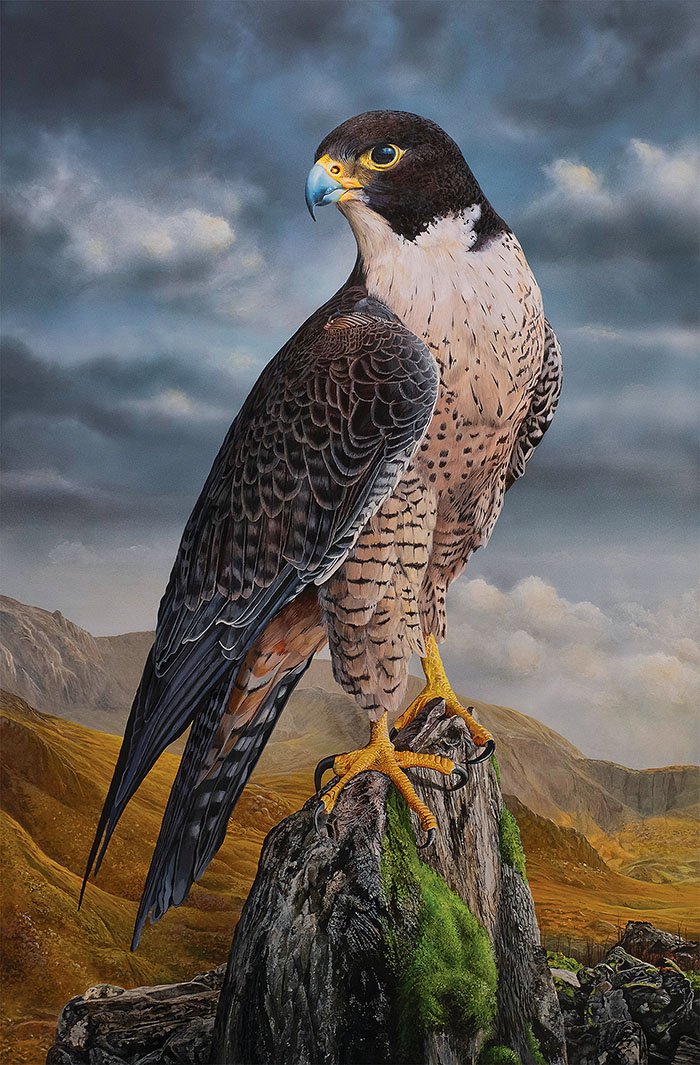
Peregrine Falcon,” acrylic, 91 × 61 cm
I love abstract and interpretive approaches too; they can capture mood, rhythm, energy, even memory, in a powerful way. But hyperrealism gives me a different language. Instead of translating nature into a symbol or gesture, I can honor it on its own terms: precise, complex, and unapologetically beautiful. It’s my way of saying, “Look closer, this is worth your attention.”
What qualities make a subject compelling enough to paint?
A subject usually becomes “paint-worthy” for me when it has something that makes me stop and really look. Sometimes that’s a distinctive feature: a specific head shape, a strange little eye-ring, an unexpected pattern in the wing coverts, or the way the light sits on the bill. Other times it’s the character of the species: bold, shy, inquisitive, mischievous, aloof. It feels like birds have real personalities, and I’m always trying to capture the moment where it comes through.
Sometimes it’s simply the pure beauty of the color combinations. Nature is an extraordinary designer. Certain birds have palettes that feel almost impossible: subtle grays against a flash of red, soft pastels with a sharp graphic line, iridescence that changes as you move. When a bird gives me that mix of structure, attitude, and color, I know there’s a painting in it.
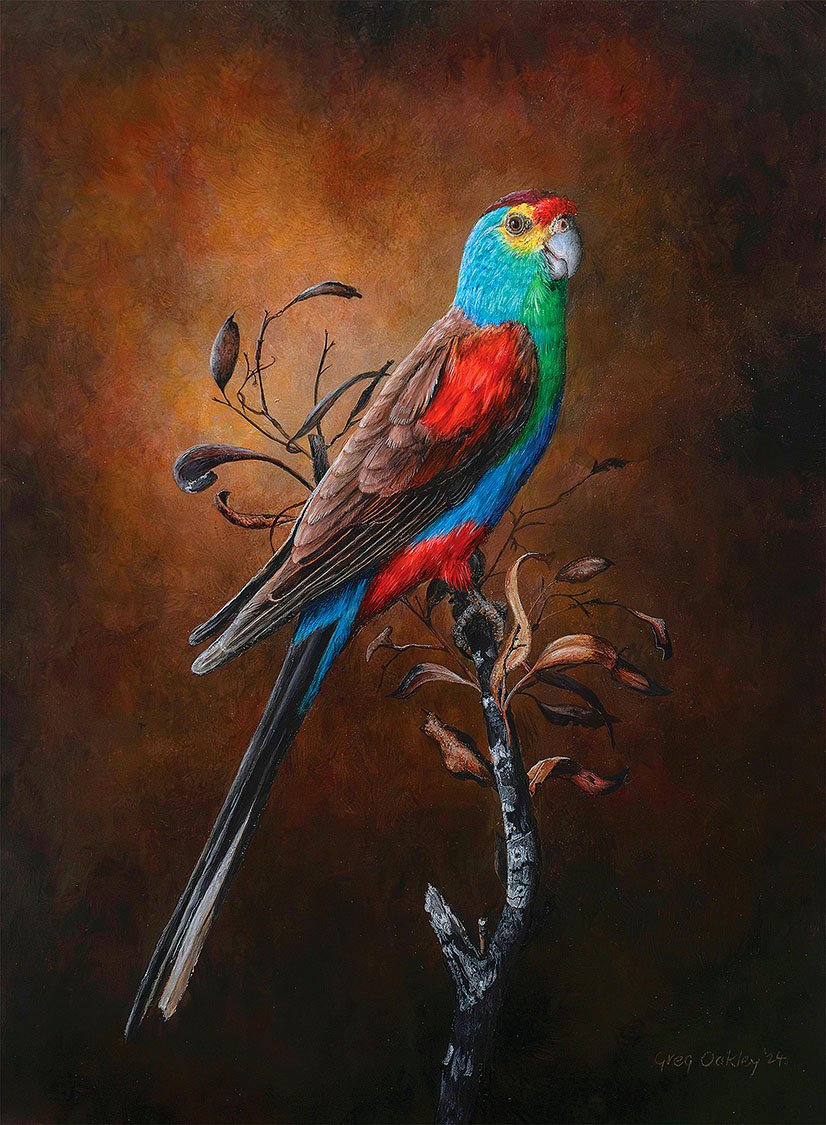
“Paradise Parrot,” acrylic, 55 x 44 cm
You often paint extinct or endangered species. Does using your art to create a record of a species drive your creative process?
It often does, but not every time. Sometimes a painting starts purely from fascination with a bird’s form, color, or presence. But when I’m working with extinct or threatened species, there’s an extra weight to it that definitely shapes the creative process. I’ve always been drawn to species that have disappeared forever; painting an animal that once lived, breathed, and filled a landscape with sound, and now exists only in specimens, fragments, and stories. It’s deeply moving — and unsettling. In those paintings, I’m not trying to be dramatic or preachy; I’m trying to make the subject feel real and immediate.
How do you go beyond photographic replication to capture the essence of the bird you are painting?
Even though I work in a realistic style, I’m not aiming to copy a single photograph. I’ll often use many reference images of the same bird — sometimes dozens — and pull the best elements from each: a cleaner head turn, better light on the wing, a more natural posture, sharper detail in the eye or feet. In the studio, it becomes a process of selection and refinement until the painting feels like the “perfect” archetype of that species, truthful, but distilled.
I also like to go beyond the bird itself by building a setting that supports the feeling I’m after. A fictitious background, even if it’s subtle, lets me shape atmosphere, light, and mood in a way a straightforward photo rarely can. That extra layer can suggest heat, humidity, distance, silence, or drama, and it changes how the viewer experiences the bird. So, the goal isn’t replication, it’s presence and emotion, something that feels like an actual meeting rather than a copy.