1st Place Winning Entry | 2025 Still Life/Florals
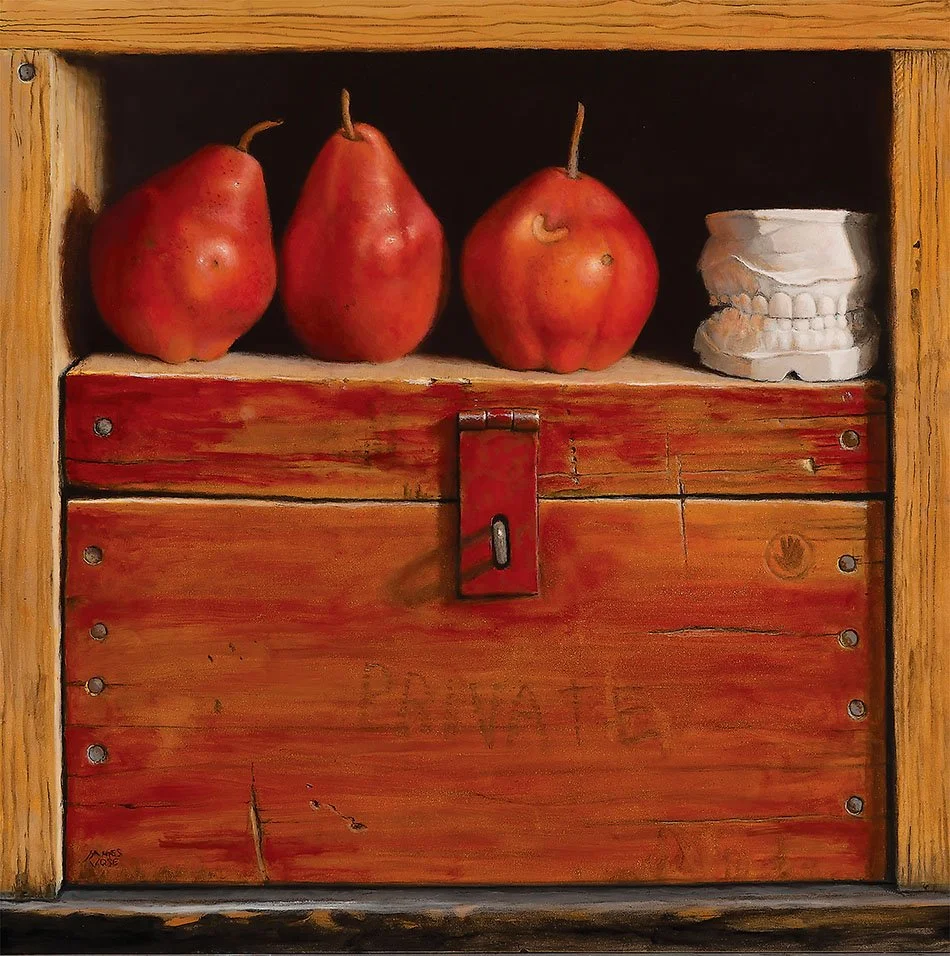
James Vose, “Pandora's Box (Temptation and Warning),” oil, 16 x 16 inches.
All images © James Vose, shared with permission.
JAMES VOSE | 1ST PLACE
2025 STILL LIFE/FLORALS COMPETITION
James Vose came to painting by an unusually circuitous route. While he practiced law for three decades, his long-standing passion for art never waned, and he found himself “stealing time in the middle of the night to make drawings and paintings.” Occasionally, he entered pieces into juried shows where, to his surprise, they placed well, which encouraged him to take the next step and seek the formal technical training he needed.
Each day on the way to his office in Minneapolis, Vose passed The Atelier — one of the first ateliers in the U.S. involved in the classical realism movement. As he describes it, “the place was calling to me,” and he finally stepped inside.
What followed was six years of rigorous, classical training in traditional methods of realist oil painting. That foundation shaped the precision that now defines Vose’s work.
He paints nearly every day, concentrating on still life in oils and graphite, depicting everything from fruit and flowers to musical instruments and children’s toys, with a focus on timeless form and the quiet drama of ordinary objects.
“Receiving instruction was like finally scratching a thirty-year itch,” Vose says. “I was completely hooked from the first day, and very shortly thereafter, I decided to throw over the law and pursue making art full-time. It was all incredible, totally absorbing fun, and still is nearly twenty years later. I have not spent even a minute in regret, excepting only that I wish I had started at The Atelier ten years earlier than I did. I cannot wait to get started at the easel every day.”
In our recent interview, Vose talked about his work.
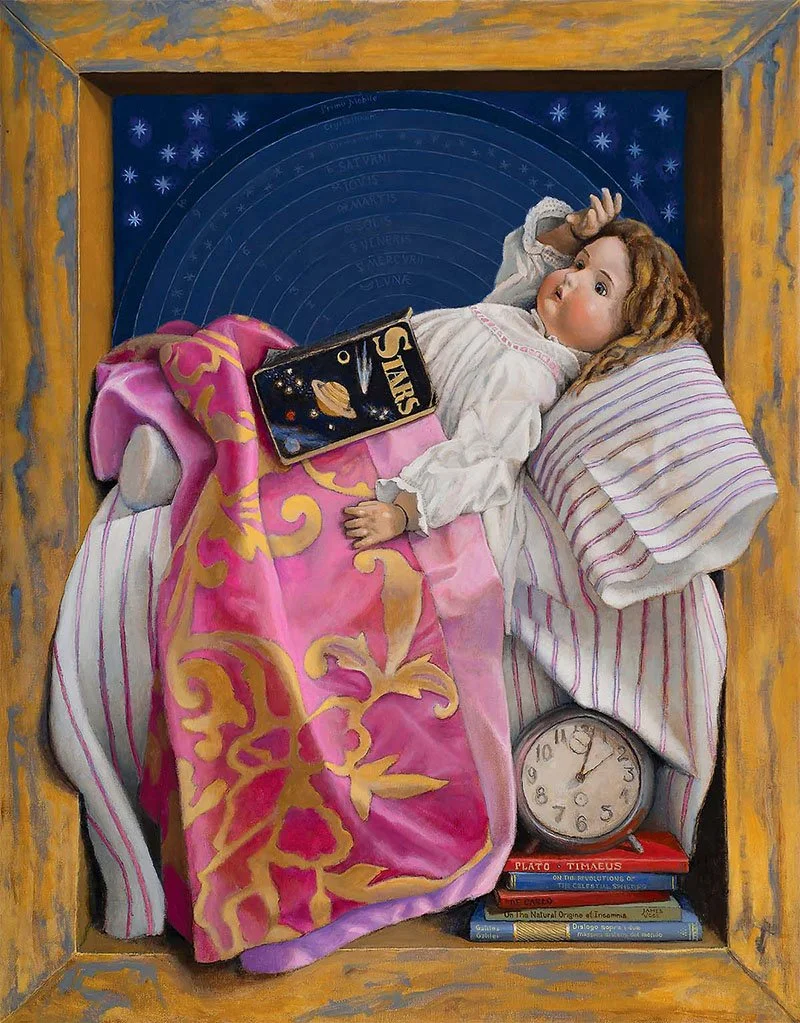
“On the Natural Origins of Insomnia,” oil, 25 x 32 inches
Where do you find the objects you paint?
I find the objects I paint at yard sales and used goods stores. I look for objects that are well-used, worn, and even broken. I like objects that look like they have had frequent contact with human hands. Of course, I also paint fruits and vegetables, so I am a frequent visitor to produce markets where I spend too much time assessing the stock, to the puzzlement, I am sure, of the other shoppers and the stock clerks.
What impels you to write descriptions and narratives for some of your paintings in your Instagram posts, and do you use titles of your work to give viewers a clue to your thinking process behind it?
Although I have sometimes done it (for example, for commission work), I do not often paint to illustrate some preconceived idea or text. Rather, I create a setup from my (much too large and ever-growing) collection of worn-out old objects. I usually tinker over a period of days, with a fair amount of arranging and rearranging, until I have an arrangement that I find visually pleasing. To me, this is a matter of harmonious shapes, colors, and balancing masses of value, after which I make a drawing that I transfer to my painting surface (sometimes linen, sometimes a panel), and then I begin to paint.
I discover the title for a painting, or the narrative (if there is one), well after I have commenced work on the painting itself, i.e., well after the composition is locked in. The titles, texts, and narratives somehow arise from the objects themselves after I have been staring at them on my setup stand for days. If I am lucky, the objects will begin to tell me a story about what they are doing together.
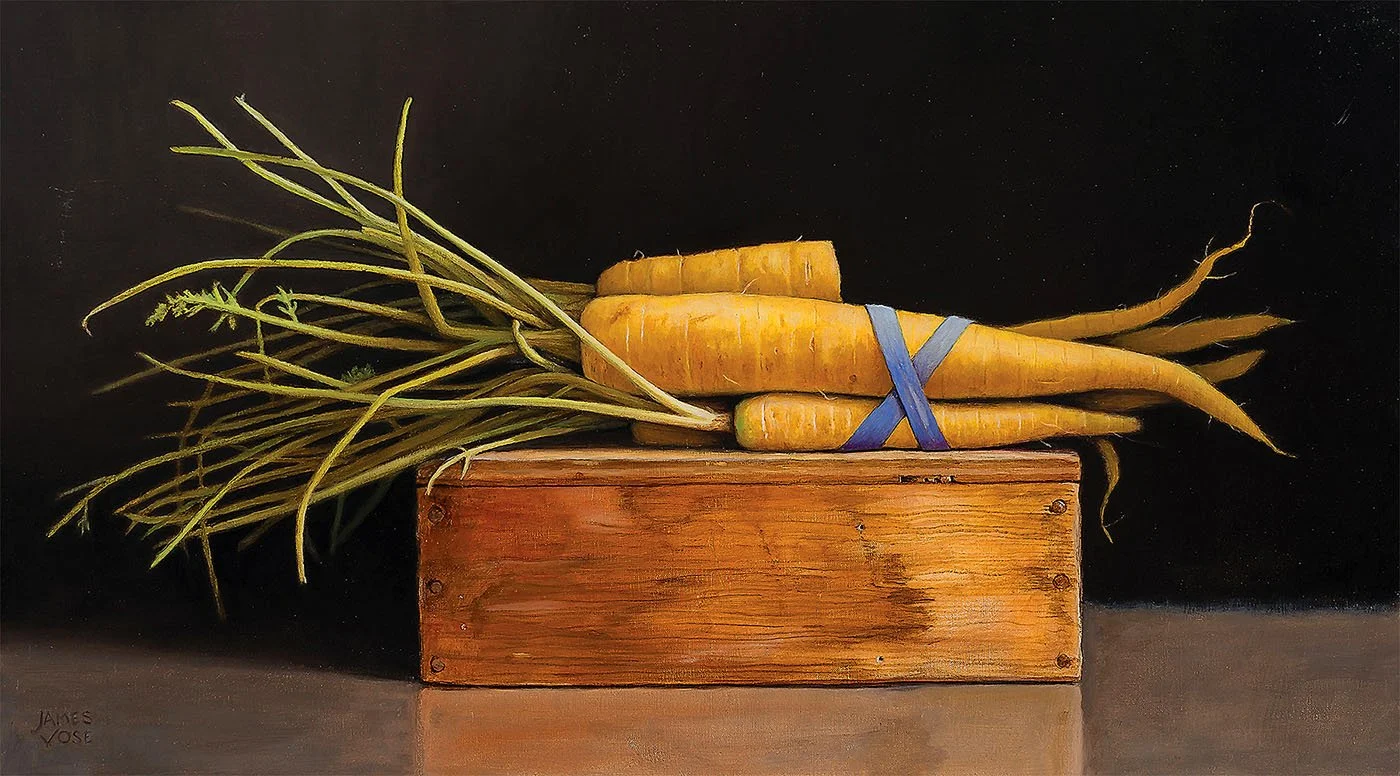
Yellow Carrots or Malvolio in the Dark Room, oil, 14 x 25 inches
Sometimes only a sentence, or a title, emerges. Sometimes an entire story emerges. This, when it happens, is nearly as satisfying as the process of putting down paint. I cannot explain this phenomenon any more articulately than this. I am sure it helps the emergence of a narrative that for my entire life I have been a very avid reader in philosophy, history, and literature. I suppose there are a lot of words rattling around in my head looking for something to attach themselves to.
But, yes, I hope that the titles and narratives do provide some insight for a viewer about what I discovered in a painting, and that they also make viewers think about objects in the world around them as something more than mere chunks and pieces of “stuff”; as something richer and more deserving of attention than mere shapes that have colors or textures. Whether objects are beautiful and interesting to look at in and of themselves is important, but it is hardly all that objects have to commend themselves to a careful viewer. Seeing should not be taken for granted.
Vose is represented by Gallery Piquel, in New Hope, Pennsylvania.
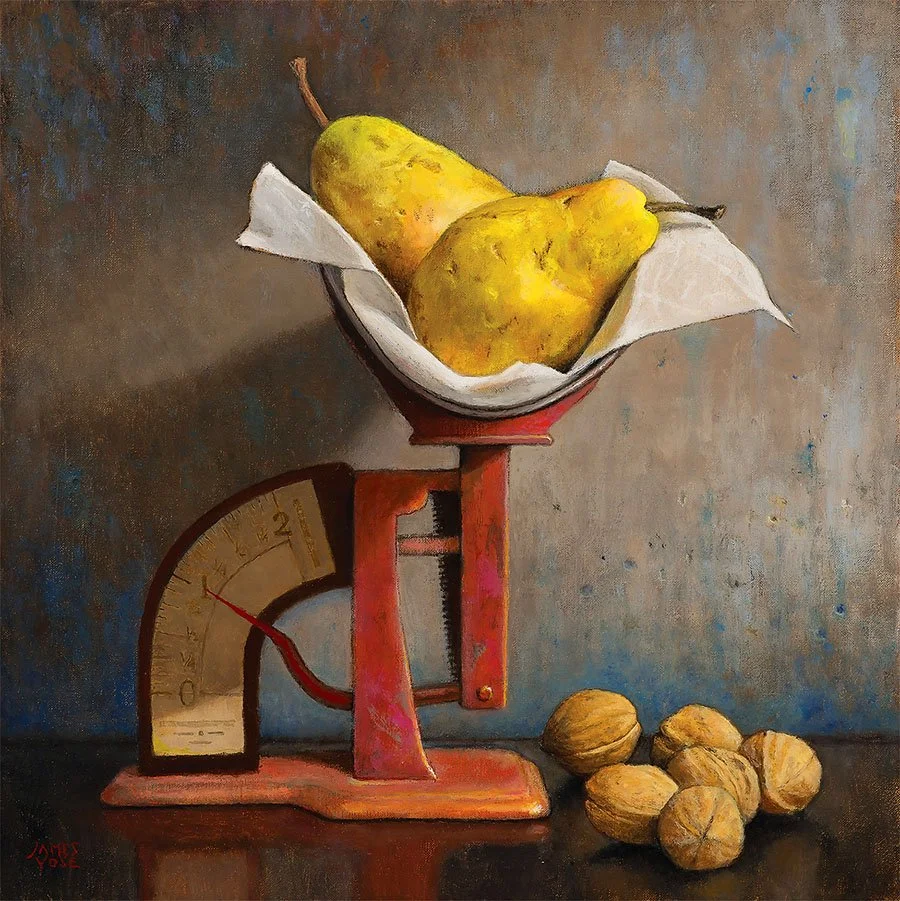
“A Pound of Pears”, oil, 13 x 13 inches
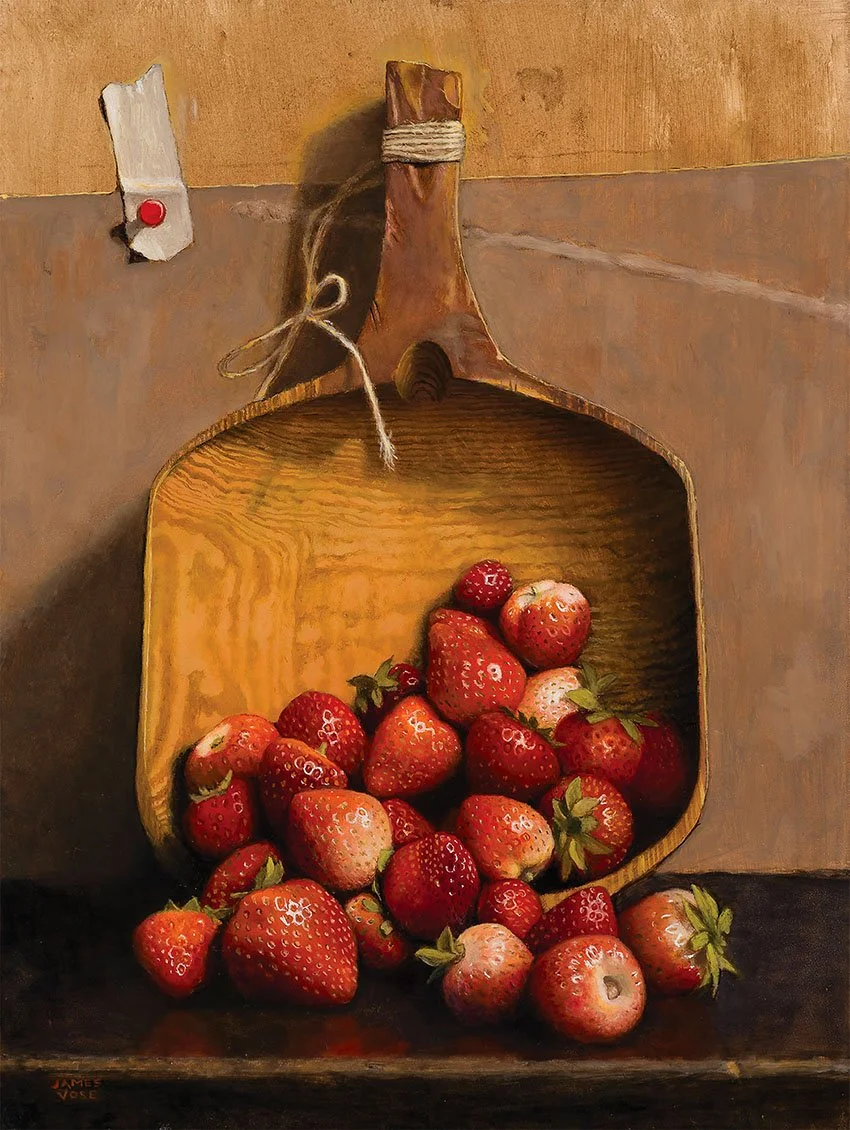
“The Strawberry Shovel,” oil, 16 x 12 inches