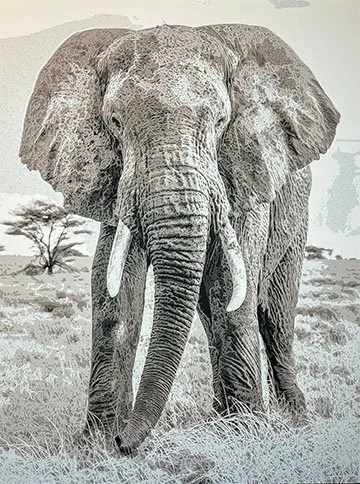
2nd Place Winning Entry | 2025 Wildlife/Animals
Sarah Lake, “Kumbuka,” hand-cut paper. All images © Sarah Lake, shared with permission.
SARAH LAKE | 2ND PLACE
2025 WILDLIFE/ANIMALS COMPETITION
Sarah Lake builds her artwork one meticulous layer at a time, turning sheets of hammered paper into complex tributes to the wildlife she loves. A self-taught artist based in Kent, she has spent more than a decade refining a practice that began as a hobby and evolved into a distinctive, award-winning voice in contemporary paper art.
Her process always begins with a single photograph — often one she’s taken herself. From that starting point, she breaks the image into layers, each printed, drawn on, adjusted for highlights, and then cut entirely by hand with a scalpel.
Lake dissects her subjects into hundreds of tiny shapes, stacking them to build depth, movement, and the quiet tension of an animal caught mid-breath. The resulting one-of-a-kind pieces feel remarkably alive, a body of work that captures the spirit of her subjects.
Lake’s rise in the art world has been steady and striking, with her name now familiar in major wildlife art competitions. Her passion for conservation is at the heart of her work, and she regularly donates original pieces to wildlife conservation organizations to help raise funds.
Recently, we spoke with Lake about the precise technique that defines her work.
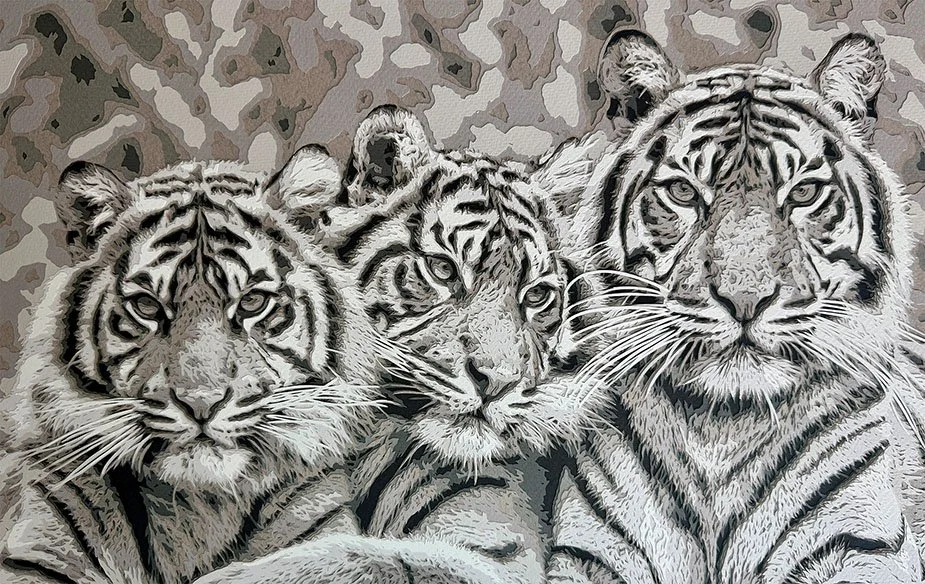
“Family,” hand-cut paper.
What first drew you to paper as your primary medium, and how has your technique evolved over time?
Paper can be used in so many ways to produce beautiful items. When I was younger, I loved origami and quilling, so paper cutting was the next step for me, and I was hooked instantly. I spent many years experimenting to find the brands and types of paper I preferred, and while I’m currently happy, I’m always on the lookout to change things up. I’m often asked about making my artwork in color, and I can see options there, but after exploring it, I still prefer grayscale.
When you begin a new collage, what does your workflow look like from initial concept to final layering?
When I start out, I either have an idea of something I want to work with, so I will search for a photograph, or I might see a photograph and think that I want to give it a go. The next step is to break down the photograph into the number of layers I want to work with, which gives me a rough idea for each layer. I then spend time drawing on each layer to add or remove pieces and areas. Once that’s done, I start cutting each layer, which is glued down before starting the next one.
Are there particular moments in the process — cutting, layering, color-matching — that you find especially rewarding?
Putting the final layer on is always the most rewarding. It’s normally made up of small parts, so it’s probably the most challenging as well. While I’m cutting, it’s a bit of an escape, almost like meditating. I’m fully relaxed, calm, and totally unaware of what is going on around me, so it definitely doesn’t feel like work.
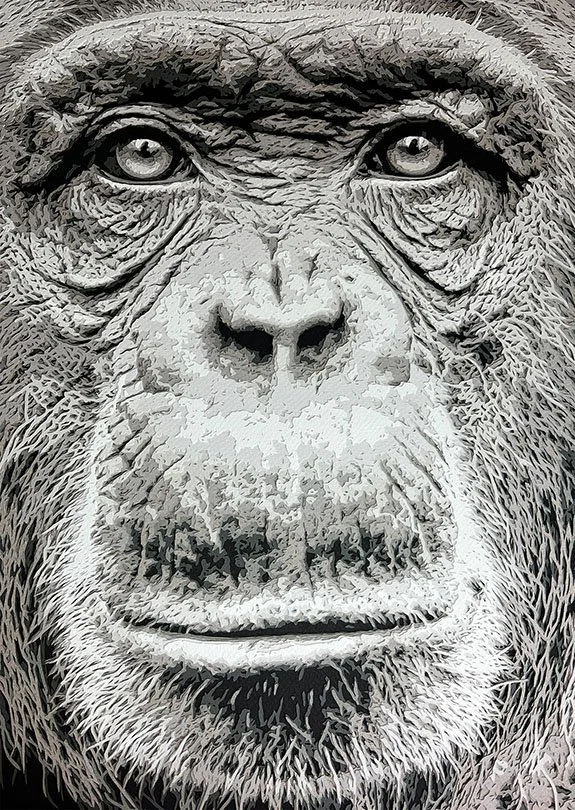
“Karibu,” Eastern Chimpanzee, hand-cut paper.
Do you take your own photographs? What are you looking for in a photo that inspires a piece?
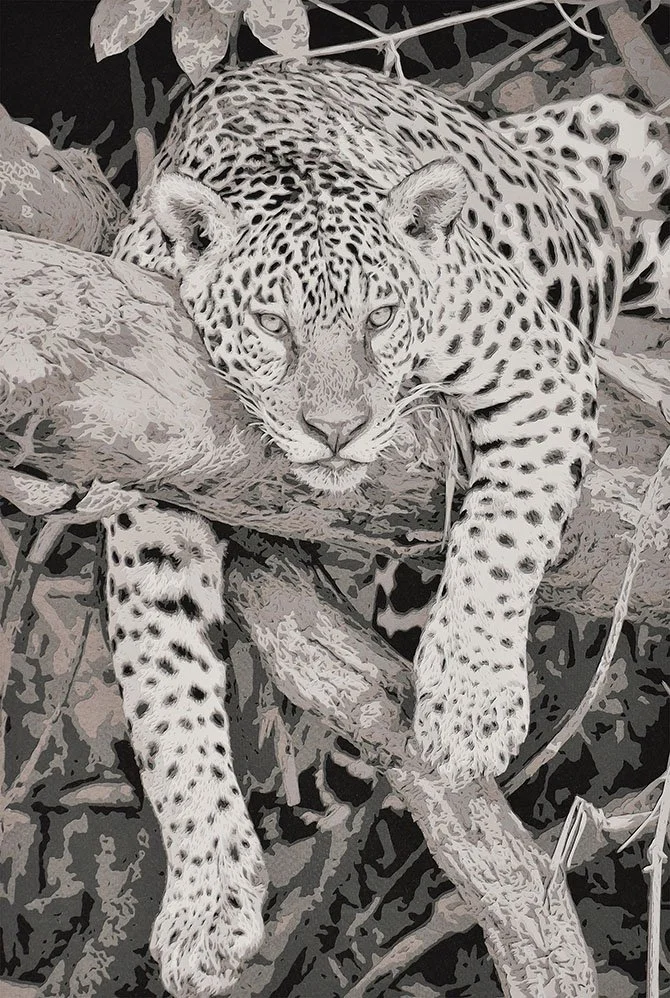
I have been teaching myself photography over the last few years, so I do use a lot of my own. I also have several very talented photographers that I am lucky enough to work with. I quite like using eye contact with my subjects, as that can really draw a viewer into a piece. But I also like something completely unexpected; for example, creating just the elephant trunk curl or an orangutan’s hand. Recently, I completed the back of an elephant walking away. Last year, I challenged myself to complete a full animal, which resulted in creating two large pieces of an elephant and a leopard.
How do you get so much detail into an image?
I started out by making images with one sheet of paper, but that gradually evolved into adding more layers and more detail over the years. I do like to include as much detail as possible in a piece. This means I go through a lot of scalpel blades; you need a very sharp blade to prevent snags or rips, which would mean having to start over again.
“Silent Watcher,” hand-cut paper.
Wildlife images are the heart of your portfolio. What sparked your connection to wild creatures both emotionally and artistically?
Wildlife has always been a huge part of family life for me from the time I was young, whether it was watching programs on television or being with my dad in the garden holding a hedgehog as he told me about them. I hope I have passed this on to my own children. I am definitely drawn to creating wildlife pieces, although I’ve also created commissioned images of weddings, flowers, classic cars, airplanes, and pet portraits.
You partner with several conservation organizations. What inspired you to connect your art with animal advocacy?
This is my favorite part of what I do. I can make something that will raise more money than I would be able to donate myself personally. Some of the charities that I work with are quite small, but do such amazing work that it’s nice to make more people aware of what they do.
Some of the charities that I have worked with over the last few years are The Big Cat Sanctuary, Cheetah Conservation UK, Helping Rhinos, The David Shepherd Wildlife Foundation, and Explorers Against Extinction. I’m hoping to add to the list this year.
What do you hope viewers take away from seeing your work?
I hope that when someone has viewed my work, it made them smile, and probably questioned my sanity (as well as my eyesight, which I’m asked about a lot — and it’s not that great). I hope they’ve been up close to see small details and then stood back to see the overall impression from afar.